Loading insight


Part 4 of the AI-Governed Enterprise Development Series. Where the money moves, what becomes visible, and how to avoid the traps

AI does not make enterprise software development cheaper. It makes the cost structure fundamentally different. The organizations that budget for the old structure will overrun, even when the technology works exactly as expected.
Much of the discussion around AI economics focuses on one thing: the cost of generating code. Yet as organizations move from experimentation to enterprise scale adoption, they are discovering that code generation is only one component of the total cost equation.
A more complete view is:
Total Cost = Execution + Control + Consequence
Execution cost: includes model inference, tool calls, agent runtime, and the direct cost of producing code. While enterprise token costs reportedly fell by 67% year over year as of May 2026, agentic workflows can generate 10 to 20 times more model interactions per task. As a result, total spending can continue to rise even as unit costs decline.
Control cost: represents the effort required to ensure outputs are correct, coherent, secure, and authorised. This includes review activities, orchestration, governance gates, escalation processes, and decision logging. Faros AI data suggests review time has increased by 91% among high AI adoption teams, highlighting how effort shifts from writing code to validating it.
Consequence cost: captures the cost of what happens when execution outpaces control. Rework, defects, compliance issues, architectural remediation, and long-term maintenance all fall into this category.
The objective is not to minimize governance. It is to find the level of control that minimizes the combined cost of control and consequence. The most common mistake organizations make is optimizing execution cost while underestimating everything that comes afterwards.
Optimal governance = the level of control that minimizes (Control + Consequence). The most common economic mistake: optimizing for execution cost while ignoring control and consequence cost.
As organizations mature their AI adoption strategies, several recurring cost traps continue to emerge.
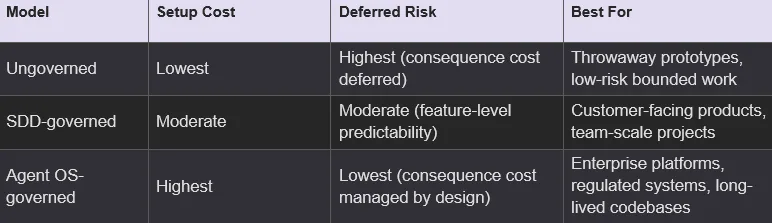
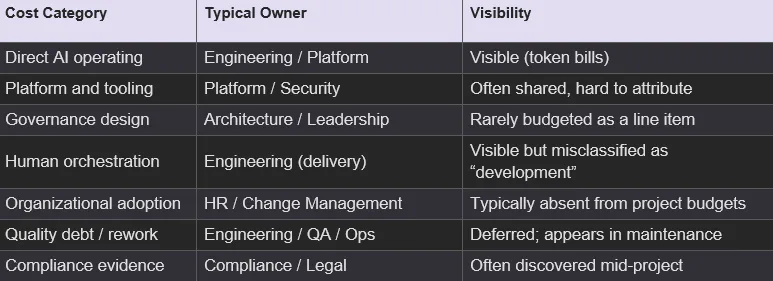
The most effective organizations measure AI economics across all three layers of the cost equation.
At the execution layer, focus on metrics such as direct AI cost per accepted change, inference trends over time, and token spend by agent role.
At the control layer, track review effort, escalation rates, specification churn, and governance overhead as a percentage of total delivery effort.
At the consequence layer, measure defect escape rates, rework within 30, 60, and 90 day windows, cost per compliant release, and the relationship between token spend and senior review effort.
If token spend dominates the cost conversation, the organization is measuring the wrong layer. The largest costs in enterprise AI development rarely come from generating code. They emerge from governing, validating, and maintaining it.
The organizations that realize the greatest value from AI will not necessarily spend the least. They will be the ones that understand where costs truly occur and manage them intentionally. Before scaling AI development, leaders should consider the following questions.
For CEOs, CFOs, CIOs/CTOs, CSOs, and General Counsel:
For technology leaders:
This brief is part of the AI-Governed Enterprise Development Series by Technossus. Full white papers available upon request.
This document was developed with the assistance of AI tools for drafting and editing.
Talk with Technossus about applying this thinking to your roadmap, architecture, or delivery model.