Loading insight


Part 5 of the AI-Governed Enterprise Development Series. Who is accountable when AI agents produce regulated software, and what evidence demonstrates it

Disclaimer: This brief describes how structured governance can help organizations address regulatory expectations. It is not legal advice. Organizations must consult qualified legal and compliance professionals.
AI-assisted development does not change what regulators require. It changes what organizations must prove.
One of the most important changes introduced by AI assisted development is not technical. It is organizational.
In traditional software development, accountability is closely tied to authorship. A human writes the code, makes the decisions, and can typically explain the reasoning behind them. Responsibility is linked directly to the author.
AI changes that model.
In AI assisted development, accountability shifts from authorship to authorization. An AI agent may generate the code, but a human remains responsible for approving the decision, accepting the output, and ensuring it falls within an authorized scope. The question is no longer "Who wrote this?" but "Who approved it, under what authority, and based on what evidence?"
This shift requires a different approach to governance and compliance.
Traditional compliance frameworks rely heavily on cognitive traceability. Regulators assume that the person who created a solution can explain why it was implemented in a particular way. AI assisted development increasingly requires institutional traceability instead. Organizations must be able to demonstrate the decision chain, authority boundaries, review process, and approval history that led to an outcome.
In practice, accountability becomes a property of the governance system rather than the individual developer.
From a legal perspective, AI has not changed the fundamental allocation of responsibility.
As of May 2026, AI systems have no legal personhood. Liability continues to reside with the deploying organization, approving individuals, and in limited cases, technology vendors. Recent policy recommendations have reinforced this direction by advocating sector-specific regulation through existing regulatory bodies rather than creating entirely new AI regulators.
For organizations operating in healthcare, financial services, or other regulated industries, this means compliance obligations continue to flow through familiar frameworks such as HIPAA, 21 CFR Part 11, SOX, and similar regulations.
What remains uncertain is not who is liable, but how organizations will demonstrate reasonable care when AI participates in development activities.
To date, there have been no major enforcement actions specifically related to AI generated code defects, no regulatory distinction between human written and AI generated software, and no established legal precedent for autonomous agent liability in production software systems.
The challenge therefore becomes evidentiary rather than legal. Organizations must be prepared to prove that appropriate oversight, governance, and review processes were in place.
The gap is not in who is liable (clearly the organization). It is in proving reasonable care. Governance artifacts become the primary evidence.
The upcoming EU AI Act reinforces this trend.
High-risk system obligations scheduled for August 2, 2026 (potential extensions under the Digital Omnibus for embedded systems). The Act regulates the output system, not the development tools. AI coding agents are generally not high-risk under Annex III. But if the software produced is high-risk (medical device, financial system, critical infrastructure), full obligations apply regardless of how it was built.
Key requirements: Human oversight (Article 14) must be effective, not symbolic. Quality management (Article 17) requires documented lifecycle management. Conformity assessment (Article 43) requires evidence before market placement. Governance architectures support these by producing the required documentation.
These obligations do not necessarily mandate a specific governance model. However, they do require organizations to produce evidence showing how decisions were made, reviewed, and approved throughout the development lifecycle.
This is where governance frameworks become particularly valuable.
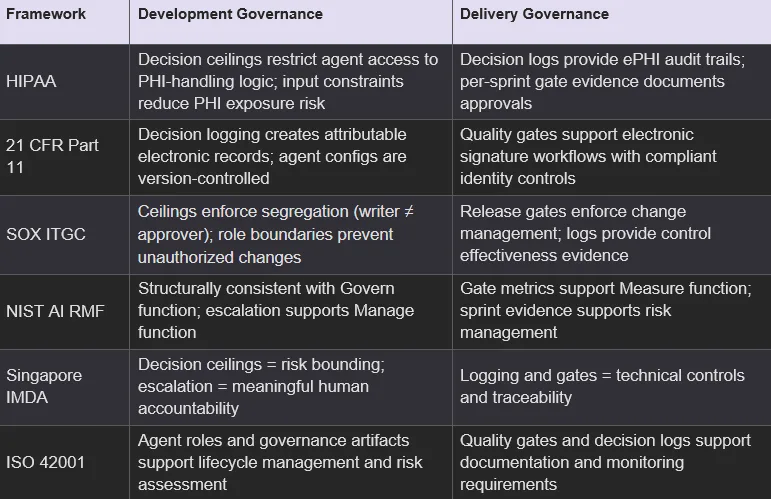 These mappings are conceptual correspondences, not one-to-one control implementations. Each organization must independently validate.
One of the more counterintuitive realities of AI assisted development is that generating code becomes easier while verifying it often becomes harder.
In regulated environments, verifying AI-generated code can be harder than writing equivalent code by hand. Faros data: 91% higher review time on high-AI-adoption teams. For regulated systems, the compliance burden per line of code does not decrease with AI; it may increase. Regulators are likely to treat perfunctory review as a governance failure equivalent to no review.
This creates what can be described as the verification paradox. As code generation becomes faster, governance and validation become more important.
Regulators are unlikely to view superficial review as sufficient oversight. In practice, inadequate review may be treated as a governance failure, regardless of whether the code was generated by a human or an AI system.
As organizations prepare for increased scrutiny of AI assisted development, four categories of evidence are likely to become increasingly important.
Together, these artifacts create the accountability trail needed to support governance, compliance, and regulatory oversight.
Governance frameworks do not automatically make an organization compliant.
They do, however, create the structural conditions necessary to demonstrate accountability, traceability, human oversight, and controlled decision making. These principles sit at the heart of most modern regulatory frameworks and are likely to become increasingly important as AI adoption continues to grow.
The question facing organizations is therefore not whether governance guarantees compliance. The more important question is whether compliance can be demonstrated without governance at all.
For CEOs, CFOs, CIOs/CTOs, CSOs, and General Counsel:
For technology leaders:
This brief is part of the AI-Governed Enterprise Development Series by Technossus. Full white papers available upon request.
This document was developed with the assistance of AI tools for drafting and editing.
Talk with Technossus about applying this thinking to your roadmap, architecture, or delivery model.