Loading insight


Part 1 of the AI-Governed Enterprise Development Series . A decision framework for matching project characteristics to methodology
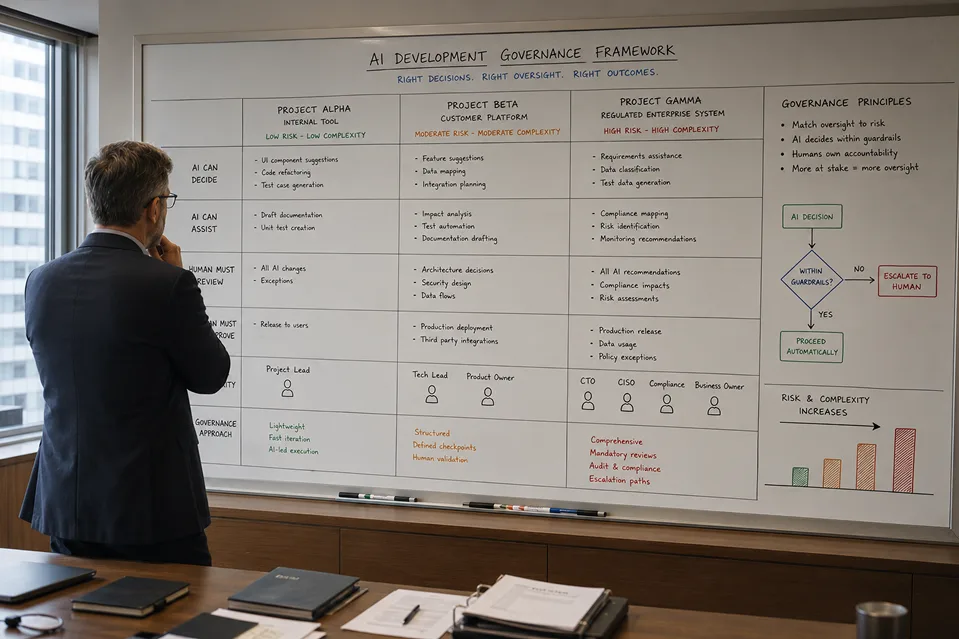
AI removes code generation as the primary constraint on software delivery. What replaces it is coordination, decision-making, and governance. In regulated industries, pure productivity without governance is unsafe to adopt. Pure governance without productivity is too costly to justify. The answer is governance proportional to risk.
Over 80% of developers now use, or plan to use, AI coding tools. Yet according to Deloitte's 2026 research, nearly 80% of organizations deploying agentic AI lack the governance structures needed to manage them effectively. This gap exposes a common mistake: treating all AI initiatives the same. Some organizations allow AI to operate with little oversight, while others apply rigid governance to every project regardless of its risk profile. Both approaches create problems. Too little control can result in compliance gaps, architectural inconsistencies, and expensive rework. Too much control can slow innovation and burden teams with processes that outweigh the risks they are meant to address. The key lies in applying the right level of governance to the right type of project.
These are not alternatives to choose between. They are additive layers. The question is: which layers does this project need?
Layer 1: Unstructured AI-Assisted Development: The developer works directly with an AI assistant through ad hoc prompting. Fast, flexible, effective for exploration, prototyping, and bounded tasks where one person holds the full context. Scope: local (one developer, one agent, one task).
Layer 2: Spec-Driven Development (SDD): Formal specifications are written before AI generates code. The specification is a contract: the agent generates, the human validates against the spec. Creates traceability and reduces variance. Scope: feature-level (one spec, one agent, one feature).
Layer 3: AI-Governed Development (Agent OS): An explicit governance architecture defines which agents can make which decisions, where authority boundaries lie, how out-of-scope decisions escalate, and how quality is enforced proportional to risk. Addresses cross-module consistency, conflicting decisions, and architectural drift. Scope: system-level (multiple agents, multiple modules, organizational decision rights).
Structural complexity determines coordination needs: system scale (LOC, modules), team and agent count, architecture (single service vs. distributed), and decision rights clarity (who is authorized to make architectural and cross-cutting decisions).
Risk profile determines governance requirements: regulatory burden (HIPAA, SOX, EU AI Act, 21 CFR Part 11), consequence of failure (inconvenience vs. patient safety vs. financial harm), maintenance horizon (throwaway prototype vs. 10-year production system), and domain criticality (content management vs. clinical logic).
The highest-risk dimension determines the minimum governance floor. A small clinical application handling patient data requires more governance than a large internal analytics platform with no regulatory exposure. Scale alone does not determine governance needs. Risk does.
One of the most common mistakes organizations make is assuming that governance requirements scale with project size. In reality, the primary driver of governance is not size but risk.
Examples: A 10K LOC clinical tool requires governance because regulation dominates scale. A 300K LOC internal analytics system may not require full governance because low consequence dominates scale. A 3-person team building a shared platform needs governance earlier than codebase size alone suggests because coordination complexity dominates team size.
Governance should evolve alongside system complexity.
Specification Driven Development becomes valuable when rework rates begin to increase, implementation quality varies across teams, or stakeholders struggle to understand what was built and why.
Introduce SDD when: rework rate is climbing, ambiguity produces inconsistent implementations, a second stakeholder needs to understand what was built and why.
A more comprehensive governance model such as Agent OS becomes necessary when integration failures increase despite individual features meeting specifications, when architectural decisions emerge without explicit human approval, when review cycles consistently take longer than implementation work, or when compliance requirements demand documented decision authority and escalation paths.
Introduce Agent OS when: cross-module integration failures increase despite features meeting specs, architectural decisions appear in code that no human authorized, review time consistently exceeds coding time, the team cannot explain why the system is structured the way it is, or compliance requires documented decision authority and escalation trails.
The goal is not to maximize governance. The goal is to apply the right governance model at the right stage of complexity, ensuring that innovation can scale without sacrificing control, accountability, or system integrity.
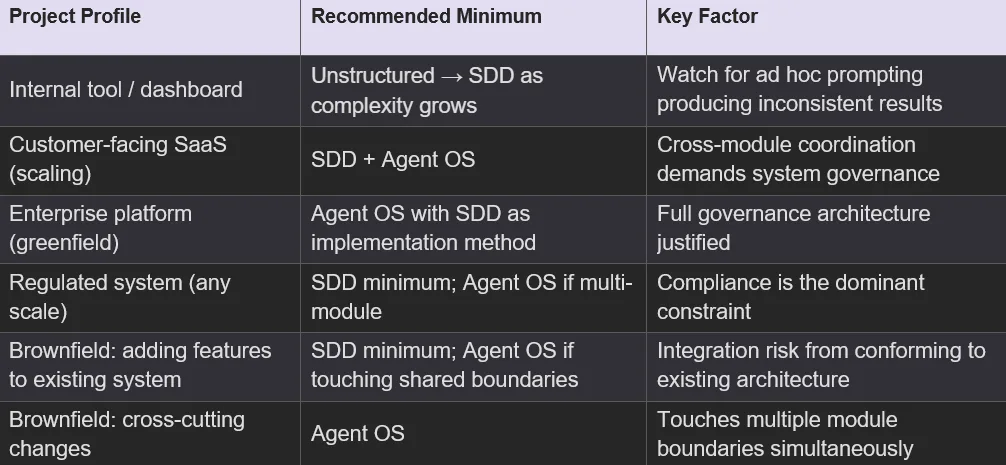
Not every project requires the same level of governance. Applying too little governance increases risk, while applying too much can slow delivery and reduce productivity. The Reference Matrix below provides a practical starting point for selecting the appropriate governance model based on project type, complexity, and risk profile.
The goal is not to prescribe a single approach for every initiative, but to establish the minimum governance level required before development begins.
As AI becomes deeply embedded in software development, governance can no longer be treated as a technical concern alone. Whether you operate in a highly regulated industry or a fast moving technology environment, leaders need clear answers to a few critical questions.
For CEOs, CFOs, CIOs/CTOs, CSOs, and General Counsel in healthcare, financial services, and critical infrastructure:
For technology leaders evaluating AI-assisted development at enterprise scale:
The organizations that benefit most from AI will not be those that move the fastest. They will be the ones that can scale AI adoption while maintaining accountability, traceability, and control.
This brief is part of the AI-Governed Enterprise Development Series by Technossus. Full white papers available upon request.
This document was developed with the assistance of AI tools for drafting and editing.
Talk with Technossus about applying this thinking to your roadmap, architecture, or delivery model.